AI False Positive Filtering
AI False Positive Filtering reviews finding evidence and marks issues it identifies as false positives with the False Positive status. Each AI verdict includes written reasoning so your team can review the decision and focus triage on actionable findings.
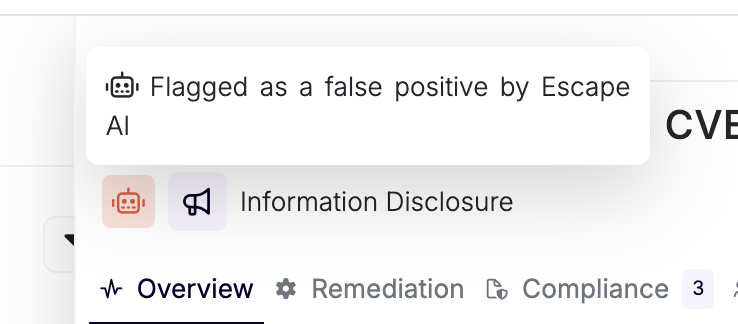 The red robot chip marks issues Escape AI auto-resolved as false positives.
What It Does
For most new issues produced by a scan, Escape runs a dedicated AI reviewer that:
- Reads the full finding context: name, severity, category, target, evidence attachments, and any rule-specific review instructions.
- Decides whether the evidence actually supports the claim, using an explicit decision matrix:
- Technically incorrect or evidence is wrong: False Positive.
- Technically correct and exploitable in context: True Positive.
- Technically correct but not exploitable in context: valid Informational or Low finding, not a false positive.
- Writes back three fields on the issue: a boolean verdict, a long-form
reasoningrendered as markdown in the issue overview, and a shortsummary. - Auto-sets the issue status to
FALSE_POSITIVEwhen the verdict is positive. The issue lands directly in the False Positive bucket: nobody on your team has to triage it first.
Review the explanation and evidence before accepting a false-positive verdict.
AI review applies to a subset of findings. Use the AI reasoning where available and review each finding's evidence during triage.
Why It Saves You Time
Reviewing a potential false positive involves:
- A security engineer reading the evidence.
- A reproduction attempt, sometimes against staging.
- A status update and a comment explaining why it was dismissed.
With filtering on, issues the reviewer identifies as false positives arrive marked False Positive, with the reasoning attached. Your team can review that reasoning alongside the evidence to confirm the status.
For continuous scans across multiple assets, this helps your team focus reviews on actionable findings.
Where You See It in the Product
- Issue row: the red robot chip appears in the issues table when the AI flagged the finding and its status is
FALSE_POSITIVE. Hovering it shows "Flagged as a false positive by Escape AI". - DAST issue overview: an AI False Positive Reasoning card shows the explanation while the AI-flagged issue has status
FALSE_POSITIVE. AI Pentesting issue side panels don't show this card. - Issue list: an AI False Positive filter (True / False) lets you slice the queue, for example to audit a sample of AI-flagged findings before trusting the system.
If you disagree with a verdict, change the status back from FALSE_POSITIVE to OPEN (or any other status). The chip and reasoning card disappear when the status changes.
AI Pentesting Feedback Across Assessments
When this capability is enabled for your organization, findings marked FALSE_POSITIVE by your team or by AI can inform later assessments on the same profile, helping Escape review recurring patterns in context.
How Escape Learns from Your False-Positive Feedback
Every time your team marks an issue as a false positive (whether you're confirming an AI verdict or overriding the AI to flag a finding the model missed), that signal feeds back into how Escape improves the system over time.
Concretely, your false-positive feedback shapes:
- Review quality: false-positive feedback helps Escape improve future reviews.
- Detector tuning: when a specific rule produces a high rate of false positives across tenants, the security research team revisits the underlying detector, not just the AI filter.
- Evaluation set: confirmed false positives become regression cases we use to validate that future model updates don't reintroduce noise we already eliminated.
We don't train a model for your organization on your data, and the reviewer doesn't read other organizations' findings.
The simplest way to help: keep marking issues honestly. Every status change is a vote on whether Escape's reviewer is calibrated for your environment.