How AI Pentesting Works
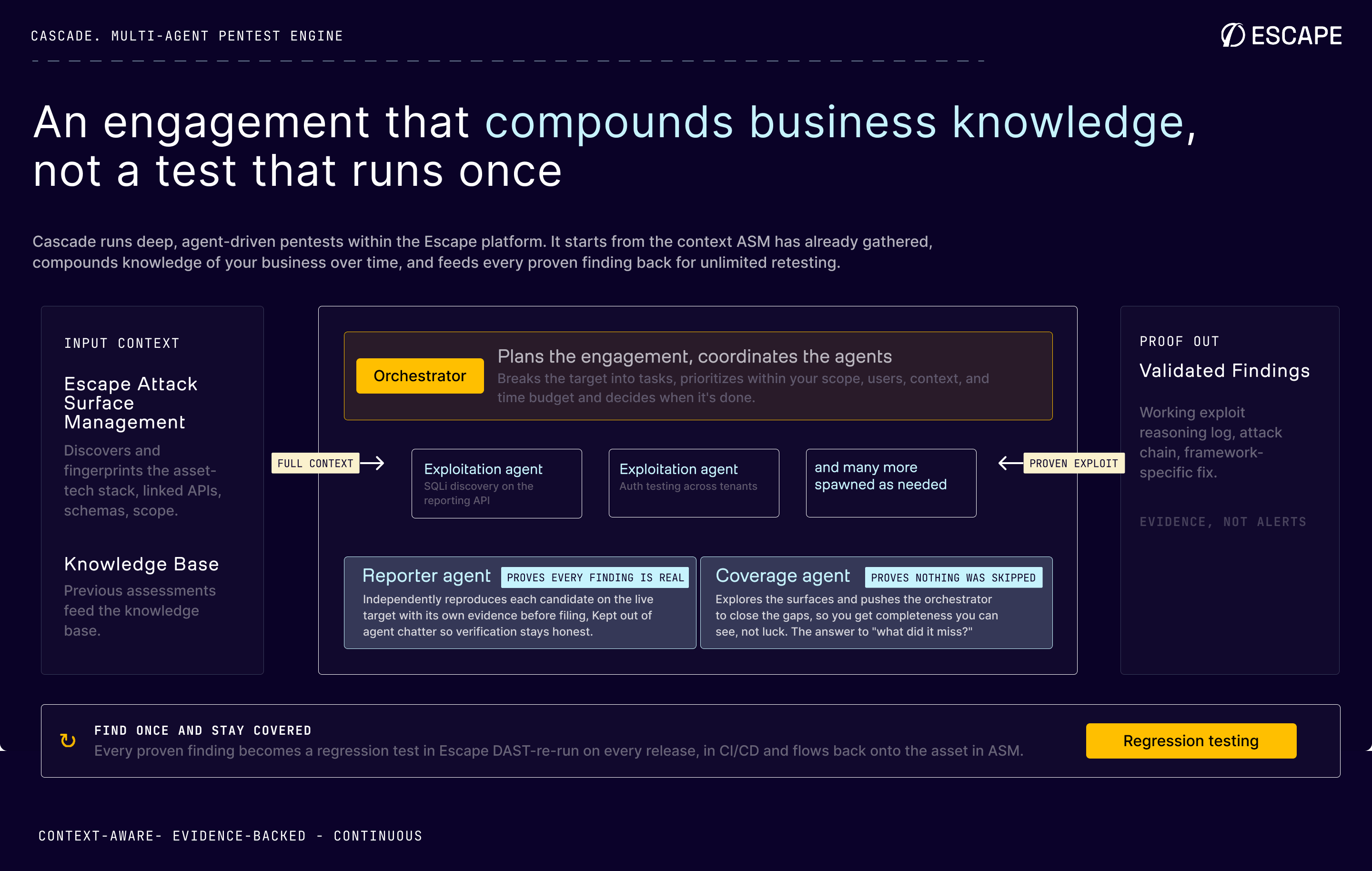
AI Pentesting runs on Cascade, Escape's multi-agent pentest engine. Cascade pairs Escape's crawling with an autonomous swarm of agents that reason about your application, attack it, and prove what they find. This page walks through an assessment from setup to evidence.
Profile Setup & Scope
AI Pentesting profiles are created from AI Pentesting > Profiles > New Profile.
The first section is scope. See Scope for modes, restrictions, Strict CDN allowances, and how enforcement works.
Before launch, Validate Configuration starts a validation workflow. It checks that Escape can reach the target, classify the listed URLs, and authenticate each configured user. Successful validation is required to launch the assessment.
Crawling
Cascade performs its own reconnaissance. Agentic crawling is the WebApp DAST crawler. It supports:
- State-aware exploration
- Natural language instructions
- Error recovery
- Context understanding
Agents use LLM reasoning to navigate web applications and discover endpoints.
Escape enforces assessment scope at the network boundary, inside agents, and in agent prompts. URL and GraphQL restrictions from the profile blocklist are applied during the run. See Scope for configuration details.
The Cascade Swarm
Cascade is an orchestrated swarm that adapts to discovered surfaces.
Four core roles drive the engagement:
- Orchestrator: plans the engagement and spawns workers on demand.
- Workers: short-lived agents for reconnaissance, exploitation, or access-control testing.
- Reporter: independently reproduces each candidate finding before it's filed.
- Coverage: tracks tested surfaces and helps identify gaps.
Attached source code informs testing.
Workers share discoveries through a message bus and a shared knowledge store. See The Cascade Engine for the full architecture, skills catalogue, and limits.
What Cascade Tests For
Cascade spins up the right specialists for the surfaces it finds. Security checks fall into these categories:
| Category | Description |
|---|---|
| Identity & Access Control | Verifying that authentication, sessions, and authorization boundaries actually hold up. |
| Business Logic | Flaws in the application's own rules and workflows rather than a specific technical vector. |
| LLMs and AI-Specific Security | Security checks targeting AI-native application components: prompt handling, model outputs, and the new trust boundaries LLM integrations introduce. |
| Injection Vulnerabilities | Classic injection classes where untrusted input reaches an interpreter. |
| Server-Side Request Forgery & File Inclusion | Flaws where the server is tricked into fetching or including a resource it shouldn't. |
| Insecure Data Handling & Uploads | Flaws in how the server processes untrusted objects and files. |
| Web & Browser Security | Cross-origin and browser-trust-model issues. |
| Data Integrity & Exposure | Issues where data can be tampered with, corrupted, or unintentionally exposed. |
| Secrets & Cryptography | Weaknesses in how credentials, tokens, and sensitive data are protected or exposed. |
| Protocol & API-Specific Security | Checks tailored to non-REST or real-time communication protocols. |
| Platform & Framework-Specific Checks | Security checks scoped to specific backend-as-a-service platforms or web frameworks. |
Cascade uses the users configured in the Authentication section to test authorization boundaries. Each user has a name and natural-language instructions that explain how to sign in and what that account should be able to access. See Authentication for configuration details.
Agents load modular skills scoped per task (vulnerability classes, tooling, frameworks, protocols, and more) rather than running a fixed playbook. See The Cascade Engine for the full catalogue.
Assessment Workflow
- Discovery: Cascade explores the application, using a pre-crawling map when agentic crawling is enabled.
- Planning: the orchestrator reasons about structure and behavior, then assigns work.
- Testing: workers execute injection attacks, access-control probes, and business-logic tests in parallel.
- Validation: the reporter independently reproduces each candidate and collects evidence.
- Reporting: confirmed issues are filed with an attack chain, impact, and a Proof of Exploit.
Agent reasoning is visible in assessment logs, showing why agents took specific actions and how they adapted their strategies. See Proof of Exploit.
AI Models
Cascade is a multi-model system: different stages of an assessment, and different agents, are powered by models chosen for the job at hand.
A Portfolio of Models
Escape routes work across a portfolio of commercial models and open-weight models. We treat models as interchangeable components and select a model for each sub-task based on continuous internal benchmarks.
Why Different Models for Different Tasks?
- Crawling & navigation: Visual and DOM reasoning, tool use, and cost efficiency. Agents click, type, and navigate thousands of pages per assessment. Speed and cost dominate. See Agentic Crawling.
- Exploit design & payload generation: Creativity, divergent thinking, and broad world knowledge. Finding a new attack path or crafting a novel payload benefits from models that explore the solution space aggressively.
- Exploit validation & confirmation: Strict, deterministic reasoning, low hallucination, and adherence to evidence. Confirming an exploit worked must be precise. A false positive here becomes a false positive in your Issue queue.
- Business logic & multi-step planning: Long-context reasoning, planning, and state tracking. Multi-step attacks (BOLA chains, workflow bypasses) require reasoning over long transcripts of requests, responses, and prior agent actions.
- Evidence summarization & remediation write-ups: Instruction-following, concision, and technical writing. The reproduction steps, cURL commands, and remediation guidance surfaced in a finding are generated from raw evidence.
Model Selection per Role
Cascade composes the stages above across its agent roles with different weightings:
- The orchestrator leans on long-context planning models to track identities, roles, and multi-step attack plans across a long engagement.
- Exploitation workers pair creative payload-generation models with reconnaissance-oriented reasoning to prioritize the highest-value surfaces.
- The reporter uses a strict validation model that only confirms a finding when the evidence is unambiguous.
- Summarization of reproduction steps and remediation guidance uses instruction-following models tuned for concise technical writing.
The exact routing, including which model is used at which step, with which prompts, tools, and guardrails, is part of Escape's private IP and is what makes the product work. Customers benefit from this routing without having to build it themselves.
Always Evaluating the Newest Models
Frontier models move fast. Escape runs every new major release (GPT, Claude, Gemini, Llama, and others) against an internal security-evaluation harness composed of real-world vulnerability reproduction tasks, benchmark applications, and regression suites. A new model is promoted only when it beats the incumbent on our metrics, not on a public leaderboard. This means:
- Improvements in upstream model capabilities translate into better findings, reproductions, and remediations without changes on the customer's side.
- If a new model regresses on security reasoning, we don't ship it, even if it's cheaper or faster.
Data Handling
Regardless of which model is used, customer data handling is governed by Escape's Privacy & Security policy:
- No training on customer data. Customer traffic, payloads, findings, and evidence are never used to train third-party models.
- Zero-retention agreements are in place with commercial model providers where available, so prompts and responses aren't retained by the provider.
- Open-weight models used in sensitive contexts run on Escape-controlled infrastructure, so data never leaves Escape's trust boundary.
- Organization administrators can disable all AI Pentesting activity at any time via the AI Pentesting Kill Switch.
What about reproducibility?
Assessments can explore different attack paths across runs. Use the reproduction steps and evidence on a finding to verify it against your application.
Related Documentation
- The Cascade Engine: Architecture, skills, and limits
- Graph Reasoning: How Cascade builds attack paths
- Scope: Standard vs Strict, restrictions, and enforcement
- Proof of Exploit: Evidence, logs, and coverage
- Agentic Crawling: Technical details on crawling